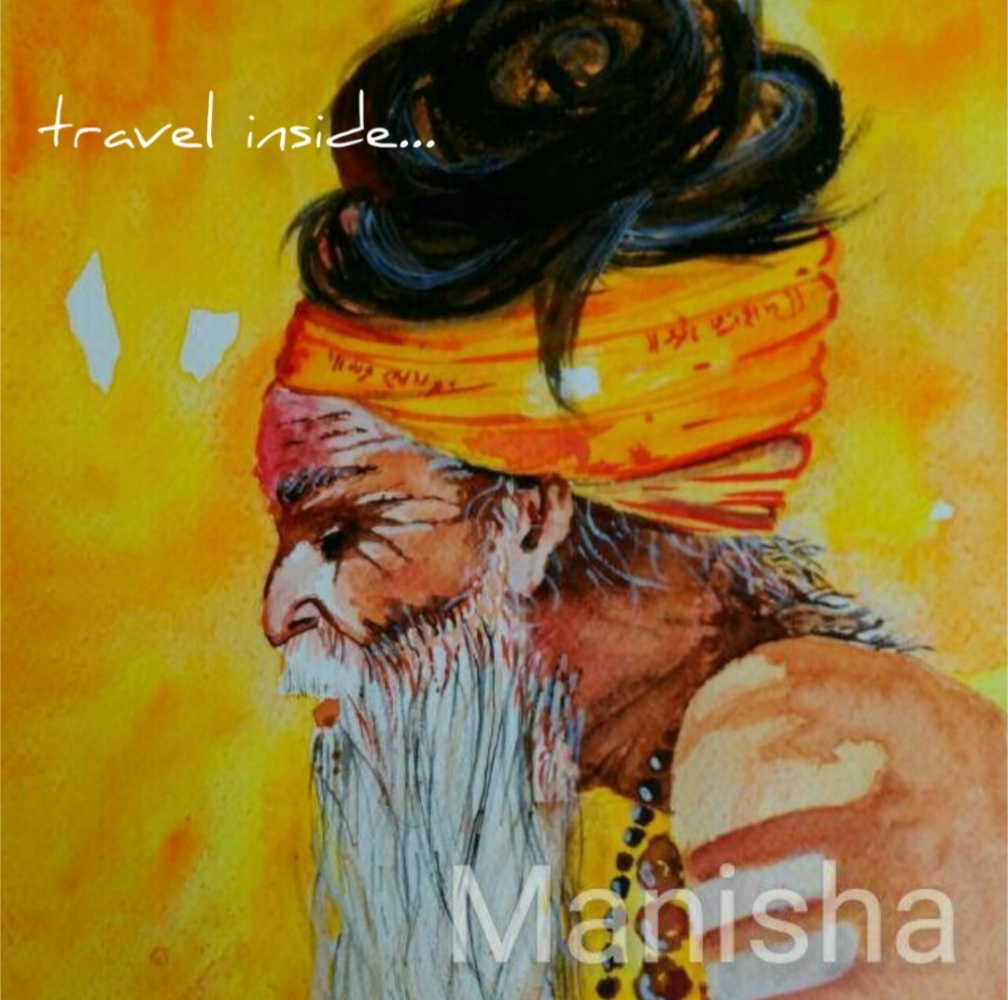
It gave me goosebumps at the idea of visiting MahaKumbh (Also referred as Kumbh or Kumbh Mela)…. After all it’s the world’s biggest fair people have been visiting for the spiritual roller coasters!
I was getting to be a part of that legacy which dates back thousands of years, observe while it happens in front of my eyes, understand as I can.
Hinduism has always embraced the Agnostics like me who prefers to sit on the fence without taking any side; questioning everything with the unresolved puzzles in the mind.
Readers should not be mistaken my (personal) idea of Hinduism for only a set of rituals and devotional beliefs. For me, in addition, it’s a rather impressive collaboration of lifestyle, nature, culture, value system, literature, science, food, art, music, costumes. An amalgamation that has evolved due to every single person living in the Indian subcontinent, yes, every person belonging to all religions!
And hence, a celebration of Hinduism is definitely of my interest too… after all, as an agnostic, I am on my quest.
Attending this event is my Samidha (offering) in the Yagya (holy fire) that has been burning from ages for finding the answers to the profound philosophical inquiries mankind has been making about the nature of one’s true self- Who am I?, questions about the world around- What is this all about? and the state of Moksha (Nirvana)- Where is Moksha and how to reach there?


There is something in this culture that has made my race survive against all odds for thousands of years…. and the Kumbh Mela is one of such threads that helps hold the legacy.
Do you look at Kumbh Mela just as a random gathering of Sadhus, Sanyasis and believers? That was my understanding too.
Who doesn’t need a good preparation for a trip like this? So, I started reading about it. It turns out its more than what I thought.
They say the greatness of a culture can be found in its festivals and gatherings. The Kumbh Mela can be looked at from various perspectives to understand it better.
The scholars in the past must have decided to organize such a periodic gathering to promote the awakening of not only spiritual but patriotic, social and cultural consciousness.
It’s a way to refresh the ideas and bring society above the Material happiness.
A reason for creating such practices must also have been to create means and ways to bring society’s attention towards social causes and welfare.
Kumbh Melas are like recurring social experiments our ancestor probably wanted to conduct to remediate the anomalies that grow in societies as time passes and bring about a revival of the institution, we call Hinduism.
Kumbh Mela provided me a first-hand experience of how faith influences millions of people.
It showcased how ancient traditions shape modern spirituality and defies the boundaries of social structures… No matter what social structures we live in everyday life, Kumbh showcased just a mass of millions with no boundaries and division of thoughts and in reality, too. Everyone walking together to one unexplainable goal. It gave a strong sense on one-ness.
Imagine, how would a culture have survived for thousands of years otherwise?
Kumbh is held at the bank of rivers. The one that I attended (Kumbh 2025) was on a conflux of 3 rivers- Ganga, Yamuna and Saraswati called as the ‘Triveni Sangam‘ (Confluence of 3 rivers).
People called it Triveni Sangam (Confluence of 3 rivers)… But I could see a fourth one flowing – The Sanskruti (Culture/Way of life). Isn’t it gushing like a river? Uninterrupted, through our lives to merge into the sea of thoughts and emotions sometimes forming pearls of wisdom for a lucky few.
Hinduism has grown and flourished around nature. Many of its festivals are meant to be the reminders to go back to nature and get humbled by it. Kumbh Mela is to worship the mother river that is nurturing the living world in the Indian subcontinent from ages. It’s a gathering to remind ourselves about the dependence of our lives on rivers. Be humble and rekindle our love for nature.
Isn’t that a reason enough why Kumbh Melas happen on the riverbanks and not at any other random place?
Want to know Kumbh from mythological angle?
The story of Samudra Manthan (Churning of the ocean) is one of the most fascinating episodes from Hindu mythology, found in the Bhagavata Purana, Vishnu Purana, and Mahabharata. Kumbh Mela has a deep connection to the mythological event of Samudra Manthan.
Fast forward version of the story goes – The Devas (Gods) and Danavas (Asuras/Demons) performed Samudra Manthan (Churning of the ocean) in pursuit of immortality and divine wisdom. A lot of treasures emerged out of this churning along with the Halahala poison. Shiva consumed it to save the world. This event gave him the name Neelkanth (Someone with a blue neck). When Dhanvantari, the divine physician, appeared out of the churning carrying a Kumbh (pot) of Amrit (nectar of mortality), a fierce battle broke out between the Devas and Asuras over its possession. It is believed that there are four places where the Amrit (nectar) drops were spilled from the pot. This grand festival of Kumbh (Pot) Mela is celebrated every 12 years at one of these four different locations in India—Prayagraj, Haridwar, Ujjain, and Nashik.
Hindu scriptures are full of Similes used to create a visual image in the reader’s mind…. This story of Samudra Manthan (Churning of ocean) symbolizes the quest for immortality and spiritual awakening.
Churning (Manthan) represents effort and perseverance—to achieve greatness
The poison (Halahala) represents challenges in life—we must face them with courage, just like Shiva.
Devas and Asuras represent the quality of life—good and evil are part of existence, but ultimately, righteousness prevails.
Amrit (Nectar) signifies eternal wisdom and spiritual enlightenment—attained only through patience, teamwork, and divine grace.
People do not seem to be unaware of the hidden meaning, but they strongly believe in this story. Observing rituals, prayers, and mass devotion offer us insights into the psychology of belief and how it translates into religious experience.
Involvement of Sadhus, Yogis, Aghori Sadhus and Naga Worriers is another perspective of the Kumbh Mela that gives it its mystic feel. The powerful and ancient sects of sadhus (saints) and ascetics form various Akharas (groups). The Akharas are monastic orders of Hindu ascetics, originally formed to preserve, protect, and spread Sanatan Dharma (Hinduism). They play a central role in the Kumbh Melas. These sects believed to have historically trained warriors (Naga Sadhus) to defend Hinduism against invaders and uphold spiritual and martial traditions.
These organizations follow strict spiritual disciplines, martial traditions, and ancient Sanatan Dharma (Hinduism) teachings. During Kumbh Mela, they lead the Shahi Snan (Royal Bath), which is considered the most sacred event of the festival… I got to see only a few of them during my visit just enough to fulfil my curiosity.
How about some astronomy?
Well, I had no idea before I started reading about Kumbh Mela. Astronomy plays a crucial role in determining the timing, location, and spiritual significance of the Kumbh Mela. The festival is deeply rooted in celestial alignments and follows ancient Vedic traditions that connect planetary movements with spiritual energies.
According to Hindu astrology, Jupiter (Guru/Brihaspati) represents wisdom and divine guidance. Its position is crucial in determining the spiritual potency of the Kumbh Mela. Indian astrology divides the observable sky in 12 areas, each dedicated to a zodiac sign (Rashi). The timing and location of Kumbh Mela are decided based on the positions of the Sun, Moon, and Jupiter (Guru/Brihaspati) in different zodiac signs.
Kumbh Mela is not simply held at random intervals. Its intricate schedule hinges on a meticulous interplay between the Sun, the Moon, and the planet Jupiter, all observed within the framework of the Hindu lunisolar calendar. Scripters explain it all.
One such reference, especially relevant for Kumbh Mela 2025 is below-
मेष राशि गते जीवे मकरे चन्द्र भास्करौ । अमावस्या तदा योगः कुम्भख्यस्तीर्थ नायके ॥
According to the Skandha Purana, when Jupiter is situated in Aries and the Moon and the Sun are in Capricorn, then Kumbh takes place in the holy place of Prayagraj.
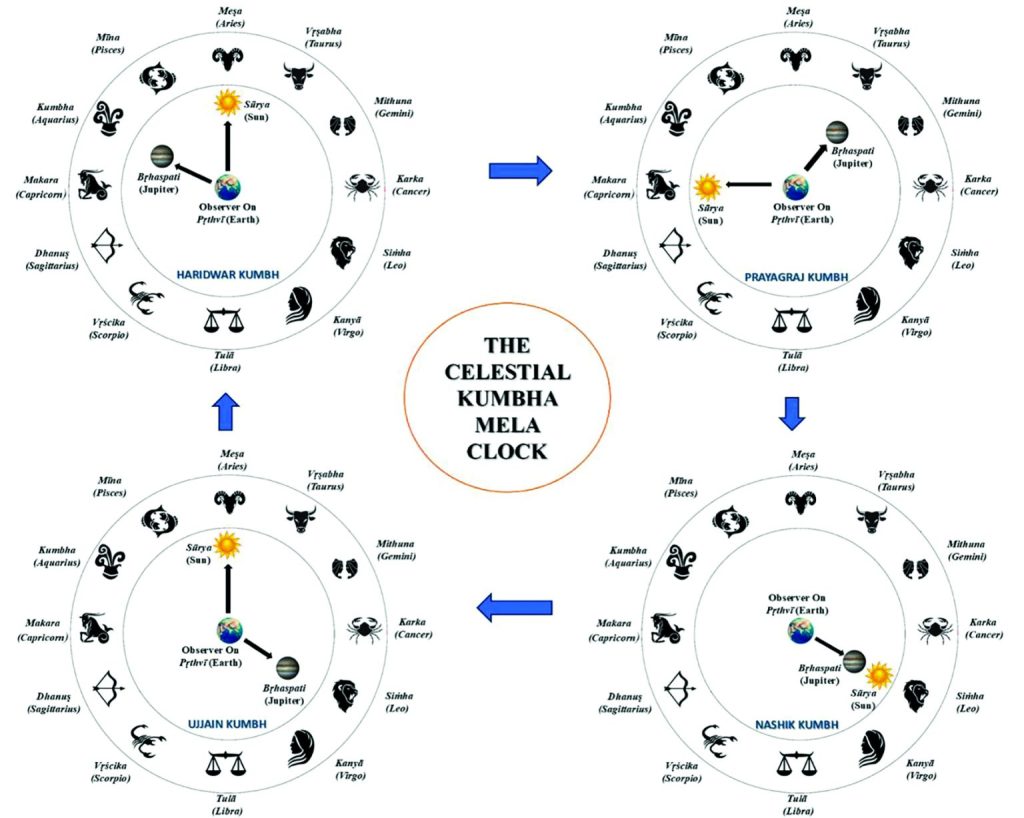
Ref: KUMBH MELA A LIVING CLASSROOM FOR POSITIONAL ASTRONOMY – ScienceIndiamag
I was amazed to read about the level of understanding our ancestors had about astronomy thousands of years ago.
Do you know why it is believed by many that Kumbh may lead one on the path of Moksha?
Yogis and others who follow Yoga believe that our body has seven power houses or energy centers.
The energy around due to planetary position, the meditation, spiritual practices and knowledge exchange with the Yogis at Kumbh are also supposed to help awaken and balance the body’s four important chakras that help Yogis reach enlightenment- Sahastrar Chakra (Crown Chakra), Adnya Chakra (Third Eye Chakra), Anahat Chakra (Heart Chakra) and Manipur Chakra (Solar Plexus Chakra/Neval Chakra).
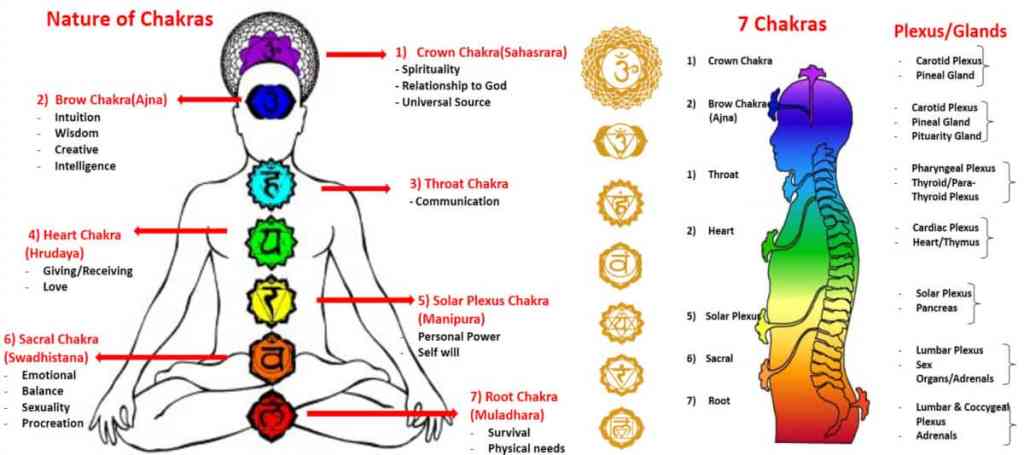
Ref: From Myth to Science: Unveiling the True Origins of Chakras – the Conscious Vibe
Another most popular perspective of all is- Visit Kumbh if you wish to wash all your sins (on a lighter note – and get ready to do more once your account balance is nil! :D)
People believe a dip in the Sangam (Confluence) brings good luck and washes all your sins. Visiting Kumbh helps you align with your own self in a spiritual angle. After all, according to Hinduism, we are not humans with spiritual experience but spiritual beings with human experience and our goal is to attain total spiritual awakening- that is- Moksha (Nirvana).
Well, who knows what is Moksha and how Kumbh helps reaching there? At least I don’t. If attending Kumbh means to take time out to pause and introspect, if it means taking off the mask one wears to portray oneself in the world, if it means to confess in mind about the wrongdoings one has done in life, if it means to plan living remaining life with hope and positivity, if it means to take an opportunity to make a conscious decision on taking the righteous path- Then, in my opinion, one has certainly taken one step towards Moksha…


Leave a Reply